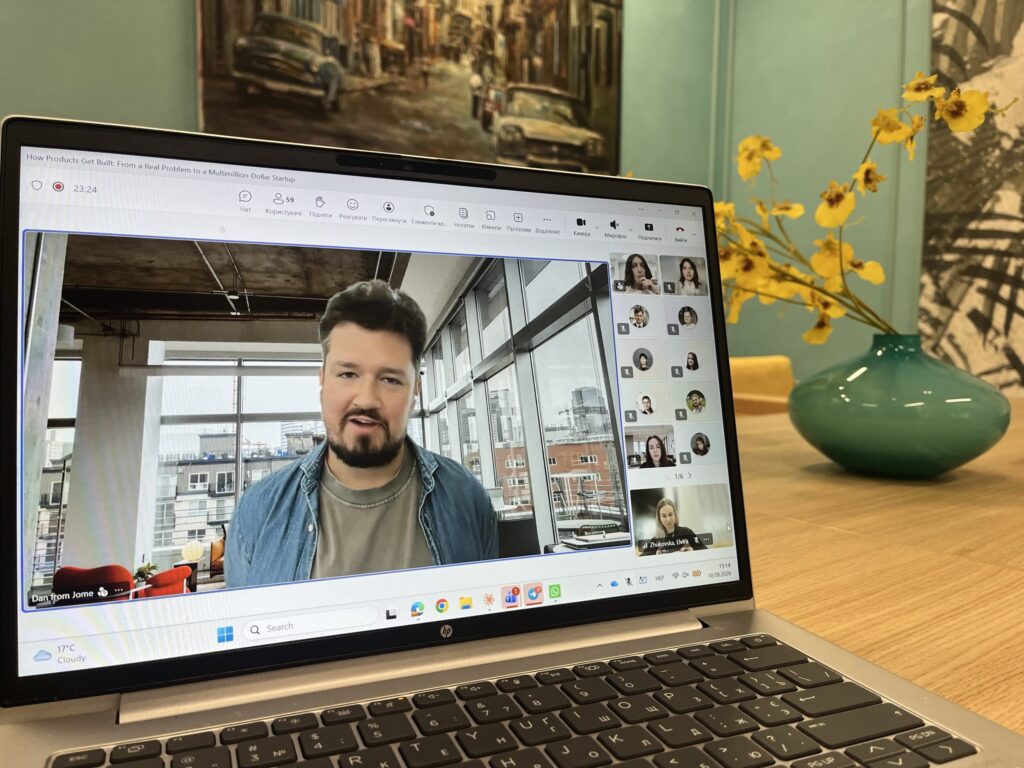
Dan Hnatkovskyy has spent most of his career building in PropTech. As President and co-founder of Jome, an AI-native marketplace for new-construction homes, he broke down how a product actually gets built – from the first hunch to product-market fit. The online session “How Products Get Built: From a Real Problem to a Multimillion-Dollar Startup” was moderated by Jane Klepa, Director of Innovation and Entrepreneurship at SET University, and hosted by Sigma Software Labs. His answers were unusually blunt about what works, what doesn’t, and where most first-time founders go wrong.
In 2020, Jome had only two months of cash runway remaining – the team had a choice: shut down or test one more idea. That idea became a marketplace that generated close to $1 billion in revenue for home builders and raised more than $17 million in funding. It started with an $8 landing-page subscription and a Google Ads campaign run off a personal credit card. Here’s what Dan learned along the way.
1. The idea is the least important part
The best products don’t start with a unique idea – they start with a great problem, a real understanding of it, and good execution. What you end up building is rarely the idea you began with. It usually starts with curiosity: Dan says he’s never met a founder who isn’t curious about the world. You notice something inefficient, catch yourself asking “why does it work this way?”, and form a view of how it should work. That vision, tested against real feedback, is where ideas are actually born. Fall in love with the problem, not your first solution.
2. Sell it before you build it
Dan’s universal reality-checker has always been the customer. When he has an idea, he tries to sell it before anything exists. With nothing built yet, the offer can be whatever the customer wants – and while you pitch, you learn what problem they really have, how they solve it today, and how much they’ll pay. Once enough people want to buy, you’ve found the moment to start building.
3. Define your “no” in advance – and write it down
Before testing anything, decide what a “yes” and a “no” look like, and commit them to paper. For Jome’s first experiment, the “no” was simple: if a lead cost more than $50, the unit economics could never work. When leads came in at $9.45, they knew they had something. Set a threshold at every stage – sign-ups, appointments, purchases – and be honest enough to stop when you cross the line.
4. Your MVP might not require building anything
Jome’s first “product” was Dan texting new leads from his own phone, simulating automated messages, then connecting people with real estate agents by hand. No code. That manual service was the business model for a full year – long enough to prove demand before building the marketplace. Bringing value and building are not the same thing.
5. Momentum is a finite resource – spend it fast

A founder runs on ambition, excitement and fear, and Dan pictures that energy as an hourglass – limited time before it runs out. So compress everything: a meeting that could happen in three weeks should happen this week. Move fast and your learning compounds. Get enough conviction to move, then protect the momentum.
6. A pivot means going back to the beginning
A pivot happens when the first principle you built everything on turns out to be wrong – a shift in the market, in customer behaviour, in where value sits. The instinct is to patch one small thing, but it rarely works: you’ve usually missed something structural. Dan’s advice: don’t tweak, rebuild from first principles.
7. You’ll know product-market fit when you feel the pull
There’s no universal metric, Dan admits – but you know it when you see it. Before PMF, nothing you try moves the needle. After it, the market pulls: every product assumption lifts conversions by 10, 20, 30%, and the more you put in, the more value comes out. It’s less a number than a sensation of demand you can’t ignore.
8. The real challenge isn’t failing – it’s surviving
Ask Dan for his biggest challenge, and the answer is one word: surviving – and not in the way founders expect. Many assume the goal is to reach profitability and relax. But if you find something that works, you’ll likely choose not to be profitable, because you’d rather keep scaling, raise more, and reach more customers. That keeps you permanently on the edge of what’s possible – and the companies everyone admires, he says, lived on that edge for years. Get too excited, and you make bad bets; get too scared, and you miss the opening. Staying alive in that tension, not any single crisis, is the actual job.
His closing note to the audience, mostly engineers weighing their own ideas, was that there has never been a better time to build. Generative AI has lowered the cost of trying, but the fundamentals haven’t changed: stay curious, bring real value to people you care about, and the rest is figureoutable.
Follow Sigma Software Labs on LinkedIn and Facebook for more founder stories. If you are building a startup and looking for a partner that brings more than investment, apply to Sigma Software Labs.